Sigma 14mm F1 8 Dg Hsm Art Lens Review
Sigma 14mm f/one.eight DG HSM Art Lens Review

Sigma has been breaking footing with many lenses in their Art series and the review-time-latest groundbreaker is this one, the Sigma 14mm f/1.8 Art Lens. The big deal this time? While there are numerous lenses covering the 14mm focal length available, no full frame lens wider than 20mm (another Fine art lens) has an aperture this wide. Astrophotographers everywhere were drooling the mean solar day this lens was announced. The promise of the high-grade optical and build quality of a Sigma Art lens combined with an ultra-wide bending focal length's power to take in a great amount of the heaven while keeping both the stars and an included foreground sharp in addition to the especially-needed widest-ever aperture were exactly what they have been longing for.
While not everyone is interested in the astrophotography capabilities of this lens, anybody will like the features that make it a neat lens for night sky photography. Ane of these features is the broad bending focal length, i able to proceed both almost and afar subjects in focus even at an ultra-broad aperture. That a lens has an ultra-wide aperture is not plenty – it must deliver splendid epitome quality at that wide aperture and this ane completely, impressively fills in that check box. The residual of the feature set seals the deal: great build quality, smashing looks, slap-up features and, for the specs of this lens, I think it has a worthy price.

Focal Length
A primary reason to want this lens is considering it has a 14mm focal length, and the focal length volition largely determine the types of photography this lens is used for. The ultra-wide 114° angle of view presented by the 14mm focal length is both very useful and extremely fun to use.
Every bit already alluded to, this lens is an splendid choice for photographing the night heaven. The 14mm bending of view takes in a large portion of the heaven and, with a correspondingly-deep depth of field, it is easy to keep both stars and foreground subjects in sharp focus, fifty-fifty at f/1.8. The wide angle of view creates rather small stars, only with the low magnification, the globe'due south rotation does non cause them to become blurred in images captured at longer exposures, meaning that lower, less-noisy ISO settings can be used.
I couldn't wait to introduce this lens to a clear, dark sky and did so at the starting time chance I got. And, with each darker, clearer nighttime heaven, I went back out. My married woman surely thought I was avoiding her, but ... the Perseid falling star shower was taking place and ... the more than images I captured, the more meteor streaks I obtained.

I should warn y'all, photographing the night heaven is very addicting and for all good reasons. If you are not already addicted, you need to attempt this. Discover a dark sky on a night dark and exist there with this lens.
Photographing architecture is some other popular use for a 14mm lens. Buildings are big and working space is often limited past other buildings, trees, ability lines, etc., making an ultra-wide angle focal length such every bit 14mm a requirement for the task. Remember that technical architecture photography often requires a level camera (or a tilt/shift lens) to go on vertical lines from converging. It is often hard to gain a mid-edifice height vantage point for such photography, simply an ultra-broad angle lens will often permit the entire building(south) to exist included in a footing-level image captured with a level (both tilt and roll) photographic camera. Any unwanted foreground tin merely be cropped away.
Interior photography is another scenario where working space is frequently limited and a wide angle of view is needed to capture the entire space. A benefit from using an ultra-wide angle focal length for both interior and exterior existent manor photography is that the angle of view makes spaces appear larger and larger is typically desired in this field.
One of the about-common uses of 14mm is in landscape photography. The outdoor earth is total of wide bending scenes pending your shutter release behind a 14mm lens. Wide angles are especially adept for making foreground landscape subjects appear big in relation to background subjects (due to perspective) while enabling the inclusion of a vast background both in the frame and in-focus. When out and nearly, await for interesting subjects with interesting backgrounds. Then move in close for the ultimate prototype, providing the viewer a strong sense of presence in the paradigm.
Nightscapes are of course included in the 14mm capabilities, just I'll also add cityscapes to the list.

I wanted to make this art sculpture, located in front end of the Maryland Scientific discipline Centre, large in the frame with Baltimore'south Inner Harbor and a colorful heaven at sunset forming the background. This focal length worked excellently for that task.
Creating a multi-shot panorama is a common technique used for photographing landscapes. Panorama image capture permits a wider overall angle of view to be recorded than a lens is otherwise capable of. Very wide bending focal lengths can capture a big scene in one frame and can provide a panorama look (wide aspect ratio) by merely cropping the top and bottom from a single image capture. While the multi-epitome pano tin create an even college resolution final paradigm, that resolution may not be needed with today's ultra-loftier resolution cameras and cropping is much easier than stitching.
Endeavor directing this lens straight up while in a forest. Lay on your back amidst interesting tall trees for an like shooting fish in a barrel-to-capture composition that, with each tree torso condign a leading line into your frame, looks bang-up.
While because this lens for landscape photography use, information technology must be understood that the 14mm Fine art lens' beautiful convex front lens chemical element precludes the use of standard threaded front filters, namely the round polarizer and neutral density filters commonly used for landscape photography. Companies such every bit Fotodiox design filter solutions for these types of lenses, only the filter holder and the filters themselves are quite large. It should likewise exist noted that a slip-in rear gel filter holder, useful for holding neutral density gel filters, is not provided. Update: Sigma has appear that the Rear Filter Holder FHR-eleven can be optionally installed on this lens either past yourself or by Sigma (for a service fee). Regardless, there remains a lot of landscape photography to be done without filters.
A 14mm lens can be a skilful choice for going underwater, allowing even larger subjects to exist framed from shut distances that avoid water clarity issues. While I would take prefered the opportunity to be in the water while photographing under the surface level, I opted for the next-best (and much less expensive) alternative: the National Aquarium in Baltimore.

Note that the ultra-broad angle of view through thick, flat acrylic aquarium walls means that light reaching the photographic camera from hard angles is unevenly diffracted, causing strong mistiness in the frame borders. So, use this illustration for true underwater photography purposes where an underwater housing dome will properly transmit light with completely sharp results obtained.
The 14mm focal length, especially with the interesting perspective it provides, can capture artistic imagery. Take advantage of perspective distortion by moving in close to brand something appear huge in relation to its environs. For instance, concur the pocket-size fish you caught close to the camera to brand it appear huge, bankroll up your "big fish" story. Use caution when including people in the 14mm frame as the simply-referenced perspective distortion may non be appreciated for portraiture.

Non merely does Mikayla's face testify perspective distortion at this close distance (see the differently-sized optics?), the close camera-to-face distance caused her to distort her own face due to the uncomfortable lens proximaty. Incidently, this image was captured at nigh minimum focus distance with f/one.eight selected. Thus, it shows both the maximum magnification and the maximum groundwork blur this lens can produce.
Back up and a 14mm lens can exist a neat choice for portraiture. In the following example, nosotros run into the interior of the restaurant where Mikayla and I concluded our daddy-girl day in Baltimore.

Mikayla is apparently the focus of the image, simply the background tells the story. Here is another instance of an environmental portrait.

When you demand to support farther, but simply can't, 14mm might be the right pick.
Considerations must be fabricated when using a 14mm focal length with flash as about do non natively cover an angle of view this wide. A diffuser (either built in or accessory) or bounciness wink (or similar) volition be required to avert a partially-lit scene.
To see how 14mm fits into the neighboring focal lengths, I'll borrow a comparison example from the Catechism EF 11-24mm f/4L USM Lens review.

The Sigma 14mm f/1.8 Art Lens is a full frame lens and though the above discussion focuses on this lens existence used on a total frame camera, it also has great uses on smaller-sensor APS-C (1.5x/1.6x FOVCF) cameras. With their smaller imaging sensor size using only the center portion of the image circle, APS-C cameras provide a narrower bending of view, similar to that of a 22mm lens on a full frame body. While the 22mm-like angle of view is considerably less extreme (falling betwixt the 20mm and 24mm examples higher up), many of the uses are the same. Fifty-fifty with far more APS-C options available to cover the 14mm focal length, none offering the highly-desireable f/1.8 max aperture of this lens.

Max Aperture
At review time, the max discontinuity in the Sigma 14mm f/i.8 Fine art Lens is 2/3 of a stop wider/faster than the widest full frame alternative, the Irix 15mm f/ii.four Blackstone Lens.
What is the broad discontinuity expert for? Stopping activity, that of either a subject in motion or a camera being handheld, in low light is an especially great benefit of this characteristic. At the low magnification of the 14mm focal length, many photographers tin get away with an f/2.8 or f/4 max aperture lens for much/most of their work. However, at that place are many scenarios where f/one.8 can make a large difference, especially in the ISO setting needed to accomplish the aforementioned image brightness.
I already mentioned the nighttime sky scenario where the earth'due south rotation becomes fast activeness relative to the dim-ness of the nighttime sky. Low light events, specially weddings, are some other great apply of f/one.viii. Being able to reduce the ISO setting to 1 1/3 stop lower than when using an f/two.viii lens tin mean ISO 2500 instead of ISO 6400, with a noise level deviation being very noticeable.
Not immediately obvious to everyone is that when a lens can be stopped down to match the widest discontinuity of a slower lens, the wider lens usually has less vignetting and this difference tin can be huge (almost 3 stops in that example).
A highly valued wide discontinuity benefit is the power to create a potent background blur. While wide angle lenses do not magnify the background plenty to mistiness its subjects across recognition, it can create enough separation from a close subject to make it stand up out amidst a distracting background. Use the images of Mikayla at the eating place (higher up) for an example of this.
A broad aperture ways a bright viewfinder, which is especially helpful in low light, and a wide aperture tin assistance in a photographic camera's low light focusing capabilities/precision.
The downsides to a wide discontinuity, primarily because of the larger lens elements required, include larger concrete size and a higher price tag.
Likewise note that, particularly under full sun conditions, a 1/8000 shutter speed may be simply marginally fast enough to avoid blown highlights at f/1.eight. Cameras with shutter speeds limited to 1/4000 may demand the assistance of a neutral density filter to keep images dark enough at f/one.8 (equally previously noted, a third-political party solution or installation of the rear filter holder would be required for ND utilise). Shooting with a narrower aperture of form remains an easy alternative, merely the background blur volition exist reduced appropriately.

Paradigm Quality
Image quality always matters highly and with the wide aperture being such a prominent feature of this lens, "How sharp is the Sigma 14mm f/i.8 Art Lens broad open?" was the large question many of us wanted answered outset. And, the lab-examination results immediately produced a "Wow!" answer to that one.
Wide open at f/one.8, this lens is very abrupt in the center of the frame. At f/ii, a slight increase in contrast and resolution is seen and another slight increase of the same at f/2.eight brings on the definition of "extremely abrupt".
Taking the testing outdoors, we adjacent wait at a pair of middle-of-the-frame 100% resolution crop examples. These images were captured using an ultra-high resolution Canon EOS 5Ds R with RAW files processed in Catechism Digital Photograph Professional person using the Standard Moving-picture show Manner and sharpness set to only "1" (0-10 scale).

Every bit is so oftentimes the case, the outdoor results lucifer our lab tests with sharpness beingness quite good at f/1.viii (even with only very light sharpening) and improving slightly at the two next full-aperture stops. I didn't include or talk about f/four results considering ... the f/two.eight results are astonishing and you will non likely discover any difference at f/four.
An ultra-wide angle lens with an ultra-wide aperture immediately draws expectations for soft corner-of-the-frame operation, at to the lowest degree at the widest apertures. But, I am happy to inform you that isn't the case with the 14mm Art lens. While improvement is seen by stopping down through f/four, corner performance fifty-fifty wide open is still skilful. Here are 2 sets of examples showing 100% crops taken from the absolute corner of 5Ds R images captured and processed the same every bit the above examples. You lot are looking at the bottom-left corner outset, followed by samples from the lesser-right corner.

Landscape photographer especially volition love these corners. There was no reason to show you f/5.six examples as the f/4 corners are extremely proficient.
I saw no discernable difference between any of the four corners to indicate an alignment issue and focus shift is similarly not an consequence.
A wide angle lens with a widest-ever aperture is going to show worst-ever peripheral shading, right? Wrong. While the just-over-iii stops of vignetting at f/1.8 is noticeable in full frame corners, this amount is similar to or ameliorate than the best of this lens' peers at f/2.4 or f/2.eight. Stop this lens down only one/3 terminate to f/two and nearly a terminate of the corner shading goes abroad and at f/2.viii, only nearly 1.v stops remains. At f/v.half-dozen, merely under one end (the amount often used equally the boundary for visibility) remains and this amount continues throughout the residue of the narrower apertures.
APS-C-format camera owners will encounter around 1 stop in the f/one.8 corners and practically none at the narrower options.
As I have repeated many times, if lens elements refracted all visible wavelengths of light identically, a lens designer's job would be a lot easier. Because they practise not, we get aberrations acquired by various wavelengths of calorie-free being magnified and focused differently.
Lateral (or transverse) CA (Chromatic Aberration) is an imperfection I readily detect. This shows as dissimilar colors of the spectrum being magnified differently with the mid and especially the periphery of the paradigm circle showing color fringing forth lines of strong dissimilarity running tangential (meridional, right angles to radii), where the greatest divergence in the magnification of wavelengths exists. While lateral CA is ordinarily hands corrected with software (often in the photographic camera) past radially shifting the colors to coincide, it is of course better to not have it in the start place. And, since this lens will exist used mostly on non-Sigma brand cameras, it is extremely unlikely that photographic camera manufacturers will load the required lens correction profile in their cameras. That ways lateral CA correction is not available for JPG format image capture and that this CA will be recorded in videos.
Allow'south expect at a worst-instance example (100% crop from an farthermost corner of an ultra-high resolution 5Ds R frame). This is the top left corner.

There should exist merely black and white colors in the image to a higher place with additional colors revealing lateral CA. The adept news is that there is very fiddling lateral CA showing hither and an especially low amount for a lens with a focal length this wide.
A relatively common lens abnormality is centric (longitudinal, bokeh) CA, which causes not-coinciding focal planes of the various wavelengths of light, or more simply, dissimilar colors of calorie-free are focused to unlike depths. Spherical aberration along with spherochromatism, or a alter in the amount of spherical aberration with respect to color (looks quite similar to centric chromatic abnormality, simply is hazier) are other mutual lens aberrations to wait for. Axial CA remains at least somewhat persistent when stopping downward with the color misalignment effect increasing with defocusing while the spherical aberration color halo shows footling size modify as the lens is defocused and stopping down one to two stops more often than not removes this aberration.
In the real world, lens defects do non exist in isolation with spherical aberration and spherochromatism by and large found, at to the lowest degree to some degree, along with centric CA. These combine to create a less sharp, hazy-appearing paradigm quality at the widest apertures.
The following example shows a neutrally-colored bailiwick in the groundwork (behind the aeroplane of abrupt focus) and in the foreground. These are 100% crops.

What nosotros see in this example is that there are some mild highlight fringing color differences, just goose egg too bad hither.
When using an ultra-wide angle lens, it is not hard to get the sun in the frame and the sunday is ane of the best sources of lens flare bachelor. Fifty-fifty with the dominicus in the corner of the frame, this lens shows merely a small amount of flare effects at f/16 and minimal flare effects are nowadays at wider apertures for a very impressive operation.
Coma is more often than not recognized past abrupt dissimilarity towards the eye of an image and long, soft contrast transition toward the prototype periphery. Coma becomes quite visible mid-frame and in the corners of images captured at wide apertures and significantly resolves when the lens is stopped down. Astigmatism is another lens image quality aspect that is frequently apparent in the corners and the pin-point stars in the night heaven are a field of study that makes these aberrations, along with some others, nearly hands recognizable to me.
Every bit this lens appeared to exist the ultimate broad angle astrophotography lens, I couldn't wait to put some stars in the corner of the 14 Art'southward frame. With increasingly darker and clearer skies, I went out 5 different evenings, hoping for improved results each time, hoping that I was peradventure slightly mis-focusing.

one | 2 | 3 | four
Corner results from the all-time prototype of each of the first four nights are shown above, and on the fifth night, I used an equatorial tracking mount. The 5th nighttime tracking mount results only confirmed the other results. While these results are relatively good in comparing with this lens' peers, at that place are all the same wings on the corner stars.
From a geometrical baloney perspective, this lens shows some of the barrel variant. The amount is not extreme and the event is rather even (vs. a mustache/wave pattern), merely if straight lines are running near and parallel to the frame borders, the curvature will be noticed.
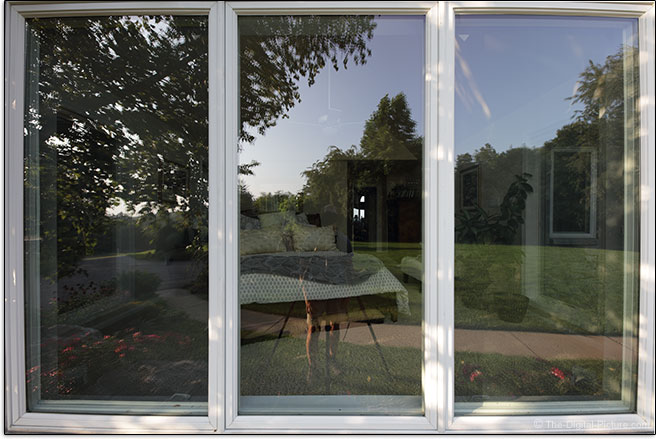
Most modern lenses have lens correction profiles available for the popular paradigm processing software programs and distortion can be hands removed using these, simply baloney correction is destructive at the pixel level and this technique is seldom equally good as using a distortion-costless lens in the first place. Again, non-Sigma cameras will not provide lens baloney in-camera for Sigma lenses, meaning that it volition show in JPG-format images and in movies.
Bokeh, the quality of the groundwork blur, is not every bit big of a business organisation with an ultra-wide angle lens equally information technology is with longer focal length lenses, merely this lens appears to create a overnice quality blur even when stopped downwardly to f/eight, where the aperture blades are greatly affecting the blur quality.

As the aperture gets narrower, indicate light sources accept on a starburst upshot and often I find that the wider the max discontinuity of the lens, the stronger the star consequence a lens can produce. The 9-blade aperture creates 18-point stars as seen beneath.

The Sigma 14mm f/1.8 Fine art Lens' optical score takes a ding from the modest barrel distortion and some coma/astigmatism showing in the corners, simply it is otherwise a stellar performer in this regard.

Focusing
Like the residue of the Art lenses hitting the street to date, the 14mm Art Lens gets Sigma's best AF system, HSM (Hypersonic Motor). At normal focus distance changes, AF locks on the subject near instantly. Do a full extent AF adjustment, from virtually minimum focus distance to infinity or vice versa, and you can hands scout the lens make its adjustment. Quiet focusing is normal for HSM systems and this one again meets that expectation with just a "shhhh" of the lens elements/groups moving during AF.
Despite the relatively deep depth of field provided past the 14mm focal length not stressing an AF system to keep subjects inside the deep depth of field, this lens still does not come shut to what I consider "good" in terms of consistent AF accurateness and the peripheral AF points did not perform as well as the center AF signal. That is of form non what I wanted to accept to tell you here, but ... that is my feel with this lens and have tripod-tested it over and over again on a pair of EOS 5Ds R bodies and an EOS 1D X Mark Ii with similar results delivered by all three. Alive view (or an EVF) type AF provides a much better accuracy experience and at this wide of an bending, transmission focusing is ofttimes an easy option.
While AF consistency cannot exist calibrated, focus calibration can exist adjusted (in item) using the Sigma Dock (more about this later).
As usual for Sigma HSM implementations, internal focusing is featured and FTM (Full Time Manual) focusing is enabled. Both are dainty features normally found on quality lenses.
The 14's effective focal length changes modestly with focusing, causing subjects to change size slightly as the focus ring is turned. Focus, establish framing and then tweak focusing to perfection for a critically-framed image.
The fourteen Art'south manual focus ring is very prissy. It is polish, has no play and has an ideal amount of rotation for precise transmission focusing even with very close subjects. The location of this ring encompassed the entire rear portion of the wide front section of the lens (a location similar to that of the Sigma 12-24mm Art Lens focus ring). The focus band is nicely-sized (larger than the 12-24 Fine art lens' MF ring), very easy to find and inherently quite broad in diameter.
The 14mm Art lens' 10.half dozen" (270mm) minimum focus distance produces a very-meager 0.10x maximum magnification. This spec lands this lens near the bottom of the chart of xiv or 15mm-capable lenses. While a college spec would be nice, it would not be very practical to decrease the minimum focus altitude because, at MFD, there is currently merely about 2.5" (63mm) of working infinite in front of the hood.
| Model | MFD | MM | |
| Catechism EF xi-24mm f/4L USM Lens | xi.0" | (280mm) | 0.16x |
| Canon EF 14mm f/2.8L II USM Lens | 7.9" | (200mm) | 0.15x |
| Canon EF 16-35mm f/two.8L 3 USM Lens | 11.0" | (280mm) | 0.25x |
| Irix 15mm f/2.4 Blackstone Lens | 11.0" | (280mm) | |
| Nikon 14-24mm f/2.8G AF-S Lens | 11.0" | (280mm) | 0.15x |
| Nikon 14mm f/2.8D AF Lens | seven.ix" | (201mm) | 0.15x |
| Rokinon SP 14mm f/2.4 Lens | 11.0" | (280mm) | 0.08x |
| Sigma 12-24mm f/4 DG HSM Art Lens | ix.four" | (240mm) | 0.20x |
| Samyang 14mm f/2.8 IF ED UMC Lens | x.eight" | (274mm) | |
| Sigma 14mm f/i.eight DG HSM Fine art Lens | 10.6" | (270mm) | 0.10x |
| Tamron fifteen-30mm f/ii.8 Di VC USD Lens | xi.0" | (280mm) | 0.20x |
| Zeiss 15mm f/2.viii Milvus Lens | ix.8" | (250mm) | 0.11x |
As shared in the distorted portrait sample picture to a higher place, at this lens minimum focus distance, the ultra-wide angle perspective distortion effect can be established.
Often, a lens' minimum focus distance can be reduced via extension tubes. However, on lenses this wide, fifty-fifty a 12mm extension tube reduces the minimum focus altitude too much to exist usable. With the lens focused to infinity, the maximum focus distance with the 12mm ET is against the forepart lens chemical element. To be usable at that focus altitude, the subject would need to be lit from behind and if you lot need that much magnification, this isn't the right lens for the purpose.

Build Quality & Features
With the Global Vision series, Sigma introduced a modern, classy-looking, tightly-dimensioned, loftier-quality design for their lenses. From the aesthetic mix of matte and gloss blackness finish to the great-feeling sharply ribbed safety rings to the nicely-shaped overall dimensions, the Art lenses all have very impressive design qualities. And, looking and feeling great lends to a high fun-to-use factor.
While this lens, actualization very similar to the Sigma 12-24mm f/4 DG HSM Art Lens including the large convex objective element, has a somewhat unique shape, it still appears to fit in with the rest of the Art-designated lens family unit.
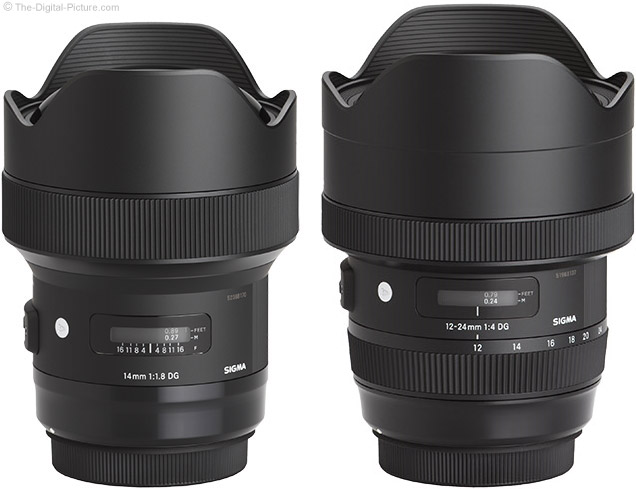
The image above shows these two but-referred-to lenses side-past-side with their shared design elements being obvious.

This is a stock-still-size lens with the focus ring and AF/MF switch existence the simply external moving parts. Equally mentioned, the focus ring is easy to find and performs very nicely. The AF/MF switch is conveniently positioned on a slightly raised switch banking company. Equally standard with Global Vision lenses, the dorsum of the switch shows white when in the auto position.
The lens hood, nicely-protecting the large convex front end lens element, is congenital-in and non-removable.
Like many of the Sigma Art lenses being introduced at this time, the lens barrel structure fabric of choice is a Thermally Stable Composite (TSC) material, used for greater precision and for better-handling wide temperature variations, with traditional metal components also being utilized.
As this is a lens that will exist frequently used outdoors, that it has weather sealing is highly appropriate and desirable.

Weighing in at 41.3 oz (1170g) and measuring 3.viii x 5.0" (95.four x 126.0mm), the Sigma 14mm Fine art lens does not proceeds entry into the lightweight club. It is only .4 oz (10g) away from equaling the heaviest lens in the nautical chart below. Still, especially because the ultra-wide discontinuity, this lens' size and weight are in line with expectations.
| Model | Weight | Dimensions w/o Hood | Filter | Yr | ||
| Canon EF 11-24mm f/4L USM Lens | 41.7 oz | (1180g) | 4.3 x five.2" | (108 x 132mm) | 2015 | |
| Catechism EF 16-35mm f/two.8L III USM Lens | 27.9 oz | (790g) | 3.5 x v.0" | (88.five 10 127.5mm) | 82mm | 2016 |
| Canon EF 14mm f/two.8L 2 USM Lens | 22.viii oz | (645g) | iii.one ten 3.7" | (80.0 x 94.0mm) | 2007 | |
| Irix 15mm f/2.four Blackstone Lens | 24.2 oz | (686g) | 4.5 x 3.nine" | (114.0 x 100.0mm) | 95mm | 2016 |
| Nikon 14-24mm f/2.8G AF-S Lens | 34.two oz | (969g) | 3.9 ten 5.2" | (98.0 ten 131.5mm) | 2007 | |
| Nikon 14mm f/two.8D AF Lens | 23.7 oz | (670g) | 3.four ten 3.four" | (87.0 x 86.5mm) | 2000 | |
| Rokinon SP 14mm f/2.four Lens | 27.9 oz | (791g) | iii.7 x 4.iii" | (95 ten 109.4mm) | 2016 | |
| Samyang 14mm f/2.eight IF ED UMC Lens | 19.5 oz | (552g) | three.4 x 3.8" | (87.0 x 96.1mm) | 2012 | |
| Sigma 12-24mm f/four DG HSM Art Lens | 40.vi oz | (1150g) | 4 ten 5.2" | (102 x 131.5mm) | 2016 | |
| Sigma 14mm f/1.8 DG HSM Art Lens | 41.iii oz | (1170g) | 3.8 10 five.0" | (95.four x 126.0mm) | 2017 | |
| Tamron 15-30mm f/two.eight Di VC USD Lens | 38.8 oz | (1100g) | 3.9 x v.7" | (98.four x 145mm) | 2014 | |
| Zeiss 15mm f/two.viii Milvus Lens | 33.iv oz | (947g) | 4.0 ten 3.9" | (102.iii ten 100.2mm) | 95mm | 2016 |
For many more comparisons, review the complete Sigma 14mm f/1.8 Art Lens Specifications using the site's Lens Spec tool.
Hither is a visual comparing of some of the above-listed lenses:
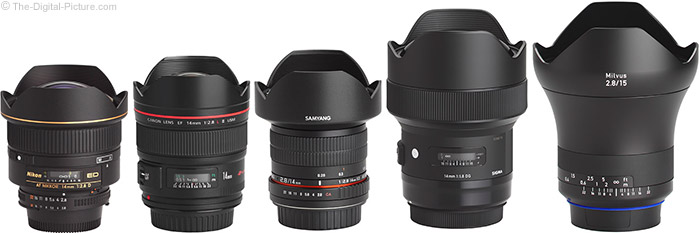
Positioned above from left to right are the following:
Nikon 14mm f/two.8D AF Lens
Canon EF 14mm f/ii.8L II USM Lens
Samyang 14mm f/2.8 IF ED UMC Lens
Sigma 14mm f/one.viii DG HSM Fine art Lens
Zeiss 15mm f/2.eight Milvus Lens
Utilize the site's product epitome comparison tool to visually compare the Sigma 14mm f/1.8 Art Lens to other lenses. That page has some other comparison you might observe interesting pre-loaded.
As already noted, this lens is not compatible with standard threaded forepart filters and installation of the Rear Filter Holder FHR-eleven is required for apply of rear drib-in gel filters. Those wanting to utilize circular polarizer and neutral density filters volition need to find a tertiary party filter holder and these use very big filters.

Unremarkably provided with lenses having integrated hoods is a lens cap that also covers the sides of the hood and that lens cap style is provided with the 14mm Art lens. This cap uses a friction fit via a thin ring of flocking-like cloth inside the hood. While staying attached is problematic for some of these caps, this 1, similar to the Sigma 12-24mm Art Lens cap, has been holding on nicely.

The Sigma 14mm Fine art Lens arrives in a squeamish zippered padded nylon case with a shoulder strap, though without a belt loop.
Sigma Global Vision and the USB Dock
Sigma's Global Vision lenses get a classification of "A", "C" or "S", representing a chief Sigma-intended use of "Artistic", "Contemporary" and "Sports". A full description of these categories can be found in the Sigma 35mm f/1.four Art Lens printing release.
Don't read too much into the category names (they are also limiting), merely Sigma has been introducing some very nice lenses nether all 3 names. This of class is an "Art" lens and every bit such, gets an "A" stamped in a swish chrome circle on the lens barrel.

A great feature of the Global Vision lenses is compatibility with the Sigma Dock. The dock, working in conjunction with the Sigma Optimization Pro software, allows the lens' firmware to exist updated (bug fixes, compatibility updates, feature enhancements, etc.) and allows precise autofocus calibration at iv distances. FTM can also be disabled/controlled via the dock. Here are some screen grabs showing some of the functionality.

The focus calibration values were ready for illustration purposes only.

Toll and Value
Non just do the Sigma 14mm and 12-24mm Art lenses share the same appearance, they also, as of review fourth dimension, share the same street cost. That fact gives this 14mm Fine art lens another title – the most expensive Art prime lens available at this time. While the loftier price will certainly limit this lens' adoption to the enthusiast and professional ranks, the unavailable-otherwise ultra-wide discontinuity combined with impressive image quality and solid build brand this lens a reasonable value in the overall market.
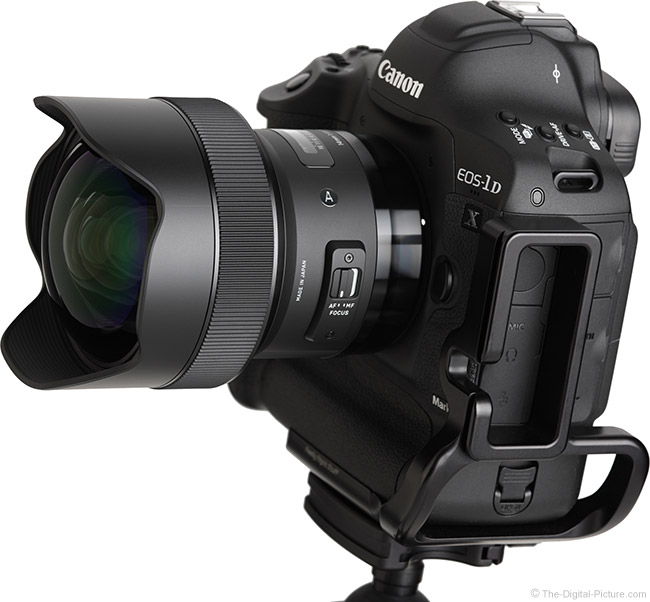
The Sigma 14mm f/1.eight Art Lens is available in Canon (reviewed), Nikon, and Sigma mounts and the Canon and Sigma versions can exist used on a Sony E-mount photographic camera body via the Sigma Mountain Converter MC-11. This lens qualifies for Sigma's Mount Conversion Service in instance yous subsequently change your heed. My standard disclaimer: In that location are potential issues with third political party lenses. Since Sigma reverse engineers (vs. licenses) manufacturer electronics and algorithms, there is ever the possibility that a DSLR body might not support a (probable older) third party lens. Usually a lens can be made compatible past the manufacturer via a firmware update, but this cannot be guaranteed. Compatibility with the Sigma USB Dock is take chances reducing equally Sigma can make dock-compatible lens firmware updates bachelor for download. Sigma Us provides a 4-twelvemonth limited warranty (Sigma'southward international limited warranty is 1 year).
The lens used for this review was obtained online/retail.

Alternatives to the Sigma 14mm f/1.8 Fine art Lens
As of review time, if you need a full frame lens wider than 20mm with an aperture wider than f/2.4, this lens is your only option. Simply go purchase the mount version you need. I will non go on repeating this large Sigma reward in the comparisons below, but proceed this special aspect in mind. If the wide aperture demands can be relinquished, the options increase.
Matching the 14mm focal length with an about-1-finish narrower aperture is the transmission-focus-but Rokinon SP 14mm f/two.4 Lens. The Sigma is sharper at f/ane.8 is considerably than the Rokinon is at f/ii.4. The Rokinon approaches the Sigma's sharpness at f/iv, just with the Sigma delivering amazing image quality at f/4, it is nevertheless the like shooting fish in a barrel winner in this comparing. At narrower apertures, the comparison becomes closer, but the Sigma retains the advantage, most notably in the extreme corners.
The Sigma has about 1-stop less peripheral shading at f/i.8 than the Rokinon has at f/2.4 and has nearly ii-stops less when compared at the f/2.viii aperture. The Sigma also has considerably less flare and barrel distortion and is atmospheric condition sealed. A Rokinon advantage is light weight (27.9 vs. 41.3 oz, 791 vs. 1170g) and slightly shorter length (4.31 vs. 4.96", 109.iv vs 126mm). The Rokinon has a longer focus band rotation, though not anybody will find the 232° of rotation better than the Sigma'southward 122°. The fact that the Rokinon is roughly one-half the toll of the Sigma (prices fluctuate, so check the current price difference) volition not be lost on most.
With a slightly narrower aperture than the Rokinon and made by the same manufacturer, the Samyang 14mm f/2.8 IF ED UMC Lens is on the radar at 14mm. Farthermost low cost is this manual-aperture, transmission-focus-just lens' biggest asset, but it is a great value lens. For most aspects of this comparison, take the differences between the Sigma and the Rokinon and extend them.
The Sigma is noticeably sharper, has much less peripheral shading, considerably less flare and far less barrel distortion with a less-complicated pattern. The Samyang weighs one-half every bit much, is considerably smaller and its focus band has twice as much rotation. The Samyang has simply 6 aperture blades (vs. nine) and is not built besides including lack of weather sealing. Again, bargain basement pricing is this Samyang'due south greatest reason for popularity.
Canon photographers volition want to consider the same-brand Canon EF 14mm f/ii.8L II USM Lens culling to the Sigma 14mm Fine art lens. I know, I'm starting to sound repetitive, but ... the Sigma is sharper at f/1.eight than the Catechism is at f/2.8. The ii are getting more than similar at f/4, but the Sigma retains the reward. The Sigma has noticeably less lateral CA, about 1.5 stops less peripheral shading at f/ii.viii, less flare and more aperture blades (9 vs. 6). The Canon has less distortion, weighs considerably less (22.8 vs. 41.three oz, 645g vs. 1170g) and has a college maximum magnification (0.15x vs. 0.10x). My AF accuracy experience was amend with the Canon than the Sigma. In this comparison, information technology is the Sigma that has the noticeably lower toll tag.
Nikon owners will of course consider their dwelling house brand 14mm choice, the Nikon 14mm f/2.8D AF Lens. I have not used this lens in the field, but was non impressed with the image quality the review sample delivered for united states of america. You guessed information technology, the Sigma is fashion sharper. The Sigma has nigh 1.six stops less peripheral shading, shows far less flare and I would rather have the Sigma's barrel distortion than the Nikon'south wave/mustache blueprint. The Nikon is smaller/lighter and has a college maximum magnification (0.15x vs. 0.10x). The Sigma has ix aperture blades vs. the Nikon's vi.
Nikon besides make a very popular f/2.viii zoom lens that covers the 14mm focal length, the Nikon xiv-24mm f/2.8G AF-S Lens. At f/ii.viii, the Sigma is sharper. Merely, the divergence is surprisingly minor for a stopped-down prime being compared to a wide open zoom. The Sigma has less lateral CA, less vignetting, less flare and considerably less baloney than the Nikon. These two lenses are not greatly dissimilar in size (the Nikon is slightly larger and lighter) and the Nikon once more has a higher maximum magnification (0.15x vs. 0.10x). The Nikon has the higher cost tag in this case, though it offers the versatility of a zoom range.
If yous can slide upwards the focal length scale to 15mm, the Irix 15mm f/2.iv Blackstone Lens, the Zeiss 15mm f/ii.8 Milvus Lens or the Tamron 15-30mm f/ii.viii Di VC USD Lens may suite your needs.
Once once more we find the Sigma winning the f/2.eight sharpness comparison versus the Irix lens, particularly in the corners and the Sigma maintains some reward at narrower apertures. At f/2.viii, the Sigma has near 3 stops less peripheral shading and also has less flare while the Irix has less distortion. The manual-focus-only Irix is noticeably smaller and lighter, accepts standard (95mm) filters and has a great price tag.
The Zeiss Milvus xv is a very impressive lens, though every bit of review fourth dimension, I'chiliad notwithstanding trying to get a properly aligned copy of this lens. Information technology has the same optical design as its predecessor, the Classic version, so I'm going to refer the before model for this comparison. I had and loved a Zeiss xv for many years, but the Sigma at least equals information technology at f/1.viii and surpasses it at f/ii.viii in terms of sharpness. The Sigma has a nearly 3-terminate peripheral shading advantage and shows slightly less flare while the Zeiss holds the distortion advantage. The Sigma is smaller than the Zeiss (with hood) merely the Zeiss is lighter. The Sigma is well-built, but the all-metal Zeiss build is as good equally it gets. If your resources are limited, the Zeiss toll is cringe-worthy.
The Tamron is the only paradigm stabilized lens represented in this set of comparisons and that reward should not be overlooked. The Tamron steps bated in the paradigm quality comparison with the prime lens turning in much sharper results than the zoom. The Sigma has less peripheral shading (though the difference is non extreme), information technology has less flare and it has less distortion. These two lenses weigh nearly the aforementioned, but the Tamron is a bit longer. The Tamron has double the Sigma's max magnification (0.20x vs. 0.10x) and a considerably-lower price tag.
If 16mm works for you, the impressive Catechism EF 16-35mm f/ii.8L Iii USM Lens should be considered. The Sigma vs. Canon comparing at f/2.8 is going to challenge you to pick a winner, but my eyes give the Canon zoom the edge. At f/2.eight, the Sigma has about 2.8 stops less peripheral shading. While these two lenses have a similar amount of distortion, the Sigma has the nicer overall baloney contour. Though similarly-sized, the Catechism is lighter (27.nine vs. 41.3 oz, 790 vs. 1170g), has a considerably-higher maximum magnification (0.25x vs. 0.10x), accepts standard threaded filters and has the zoom range versatility advantage. My AF accuracy experience is considerably better with the Catechism than the Sigma.
Though f/4 is in a different league than f/ane.eight, those not needing a wide aperture at 14mm should also consider the Catechism EF 11-24mm f/4L USM Lens and the Sigma 12-24mm f/iv DG HSM Art Lens.
Summary
So, is the Sigma 14mm f/1.8 Art Lens the all-time wide field astrophotography lens? Yeah, as of review time, I recollect information technology is. As popular as astrophotography is, I'm surprised past the lack of standout wide field lenses bachelor for this purpose. The 14 Art'due south corners are not perfect, merely with excellent broad open up image sharpness and a low amount of peripheral shading, this lens gets my vote as the best pick for capturing the night sky.
Easy to say is that this is the all-time 14mm f/1.viii DSLR lens ever produced, every bit in that location has never been another. Non hard to fence is that the Sigma 14mm f/1.8 Art Lens has the best 14mm epitome quality bachelor to appointment. This lens delivers impressively sharp images, ranking very loftier in the unabridged field of lenses (non but among its ultra-broad peers). The design of this lens is aesthetically pleasing and the build quality similarly-expert. The toll will ready y'all dorsum a noticeable amount and the AF organisation may non leave you impressed, only the other aspects of this lens volition make it a height choice for fulfilling the critical ultra-wide bending needs in many serious kits. Prepare to say "Wow!" when reviewing your images.
Bringing y'all this site is my total-fourth dimension task (typically 60-eighty hours per week). Thus, I depend solely on the commissions received from y'all using the links on this site to brand any purchase. I am grateful for your back up! - Bryan
My Recommended Sigma 14mm f/i.viii DG HSM Art Lens Retailers
Rent the Sigma 14mm f/1.8 DG HSM Art Lens
The Tip Jar
Bryan Recommends Buying It Here
Source: https://www.the-digital-picture.com/Reviews/Sigma-14mm-f-1.8-DG-HSM-Art-Lens.aspx

Post a Comment for "Sigma 14mm F1 8 Dg Hsm Art Lens Review"